
5 min read
How to Have Good Posture: A Complete Guide to Improving Your Health While Working Seated
Apr 29
Nowadays, spending long hours in front of a computer is completely normal. Almost everyone does it, whether for work, school, or even entertainment. The problem is that, over time, it starts affecting your posture without you even noticing, and it’s very common to end up with back or neck discomfort, or just feeling tense.
If you’re reading this, chances are you’ve asked yourself more than once how to have good posture, especially if you spend a big chunk of your day sitting in front of a screen.
The goal of this article is to help you with that in a simple, realistic way. It’s not about making extreme or complicated changes, but about adjusting small everyday habits that, over time, make a big difference. You’ll also find practical tips, exercises, and stretches you can apply without having to overhaul your whole routine.
Why Is It So Important to Learn How to Have Good Posture?
Before diving into techniques and exercises, it’s important to understand why knowing how to have good posture is so essential.
Poor posture can lead to:
Chronic back pain
Tension in the neck and shoulders
Spinal problems
Constant fatigue
Reduced productivity
On the other hand, learning how to have good posture improves your quality of life, your energy, and even your mood.
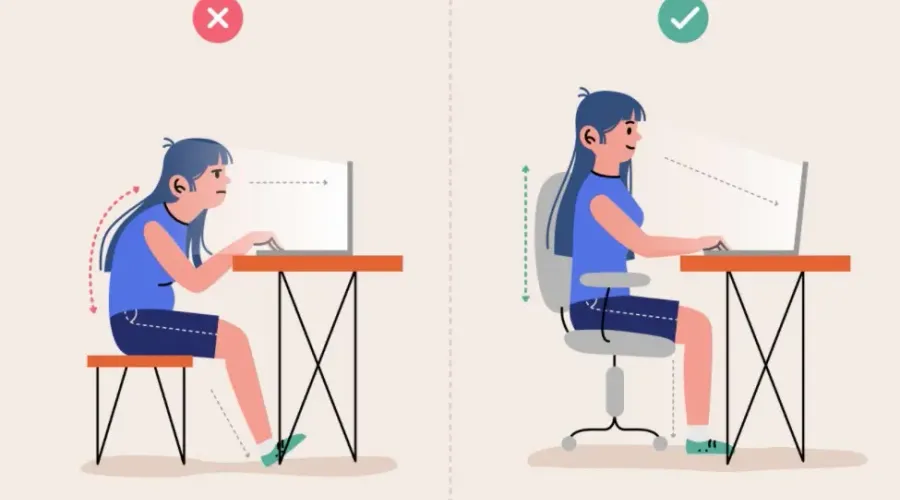
What Is the Correct Sitting Posture?
One of the most common questions is: what’s the correct posture for sitting? The answer isn’t complicated, but it does take consistency.
To achieve the correct sitting posture, follow these points:
Back straight and supported against the backrest
Shoulders relaxed, not hunched
Feet fully flat on the floor
Knees at a 90-degree angle
Screen at eye level
Adopting this correct posture in front of the computer is one of the most important steps to understanding how to have good posture in your daily routine.
Common mistakes you should avoid
If you want to learn how to have good posture, you first need to identify what you’re doing wrong.
1. Hunching forward:
This is the most common mistake. Many people move their head closer to the screen, creating tension in the neck.
2. Constantly crossing your legs:
This affects circulation and spinal alignment.
3. Not using the chair’s backrest:
Good body posture requires lower back support.
4. Poorly positioned screen:
The wrong height forces your neck into uncomfortable positions.
Correcting these mistakes is key for anyone looking to effectively learn how to have good posture.
How to correct poor posture step by step
If you’re wondering how to correct poor posture, here’s a practical approach:
Step 1: Body awareness
The first step to learning how to have good posture is being conscious of how you’re sitting.
Step 2: Adjust your workspace
Optimize your desk to maintain correct posture in front of the computer.
Step 3: Strengthen your back
To improve your back posture, you need strong muscles.
Step 4: Take active breaks
Get up every 30-60 minutes.
Step 5: Practice consistently
Knowing how to have good posture is useless if you don’t apply it every day.
How to celebrate Mother’s Day at work
Exercises for good posture
An essential part of learning how to have good posture is doing specific exercises.
1. Scapular retraction
Squeeze your shoulder blades together
Hold for 5 seconds
Repeat 10 times
This exercise helps improve body posture.
2. Plank
Keep your body straight
Engage your core
30 seconds per rep
Strengthens your body to help maintain good posture while sitting.
3. Chest stretch
Place your arms against a wall
Lean your body forward
Ideal for anyone looking to correct their posture.
4. Superman
Lie face down
Lift your arms and legs
Perfect for improving back posture.
These are some of the best exercises for good posture that you can do at home or in the office.
Essential everyday stretches
Besides exercising, stretching is a key tool for understanding how to have good posture, especially if you spend many hours sitting. Muscles tense up easily when you stay in the same position, and this ends up affecting your body alignment.
Adding simple stretches throughout the day not only reduces discomfort but also makes it easier to maintain correct sitting posture without effort.
Neck stretch (releases cervical tension)
This stretch is ideal for anyone who feels stiffness in the neck from constantly looking at the screen.
How to do it correctly:
Sit with your back straight
Gently tilt your head to one side (as if trying to touch your shoulder with your ear)
Hold the position for 15-20 seconds
Switch sides
Repeat 2 or 3 times per side
Avoid sudden movements. The key is gentleness.
Back stretch (spinal decompression)
Perfect for relieving pressure that builds up in the lower back.
How to do it:
Stand with your legs slightly apart
Slowly bend forward, letting your arms hang down
Don’t force the movement, let gravity do the work
Hold the position for 20 to 30 seconds
This exercise directly helps anyone looking to care for their spine and improve their back posture.
Shoulder stretch (opens the chest and corrects hunching)
Ideal for counteracting the hunched posture typical of desk work.
Cross one arm in front of your chest
With your other hand, gently push the arm toward your body
Hold for 15-20 seconds
Switch arms
This stretch improves chest opening, something essential for mastering how to have good posture.
How to Maintain Correct Sitting Posture All Day Long
Knowing how to maintain correct sitting posture isn’t just about getting comfortable once, it’s about sustaining that habit throughout the entire day.
This is where many people fall short: they start off well, but as the hours go by, they slip back into hunching.
Practical keys to maintaining good posture:
Use an ergonomic chair:
It should allow your back to be fully supported, especially your lower back.
Adjust your monitor height:
The top of the screen should be at eye level. This keeps you from tilting your neck.
Keep your feet firmly on the floor:
Avoid constantly crossing your legs. This affects pelvic alignment.
Knees at 90 degrees:
A neutral position avoids unnecessary tension.
Avoid leaning forward:
Getting too close to the screen is one of the biggest enemies of correct posture in front of the computer.
Applying these habits daily will let you master how to have good posture automatically, without having to think about it so much.
Real benefits of having good posture
Adopting correct posture isn’t just about looks. Learning how to have good posture has profound effects on your health and daily performance.
Main benefits:
Less back and neck pain
More energy throughout the day
Better breathing (more oxygen = more focus)
Greater confidence and self-assurance
Better work performance
When your body is aligned, everything works better. That’s why mastering how to have good posture directly impacts your quality of life.
Conclusion
Learning to have good posture is more important than we often think, especially if you spend much of the day sitting, whether working or studying. It’s not just about knowing what it should look like, it’s about making small changes day by day.
Simple things like adjusting your chair, positioning the screen, standing up for a moment, or stretching a little might seem like small details, but over time they make a big difference.
In fact, once you start incorporating them, you’ll notice your body feels less tense, the aches ease up, and it even helps you concentrate better without as much effort.
And in the end, it’s not something achieved overnight. It’s more of a process, something you build little by little until your body gets used to it and does it naturally, without you having to think about it so much.
By Diego Ramos — April 28, 2026