
5 min read
June Festivities in Peru
May 6
In this article, you’ll find the main festivities of June, what each one celebrates, how they’re experienced, and why they still matter today.
The Importance of June Festivities
June festivities play a very important role in the social and cultural life of many communities. Through them, people remember historical events, honor their religious beliefs, celebrate their families, and take part in activities that strengthen collective identity.
hotels in San Isidro
can be a great option, especially for those looking to stay in a central, comfortable, and well-connected area.
June festivities also allow traditions to pass from one generation to the next. Children learn about their community’s customs, adults reminisce about the celebrations of their childhood, and families find an opportunity to come together and share.
Enjoy These Special Dates in June
1. Corpus Christi
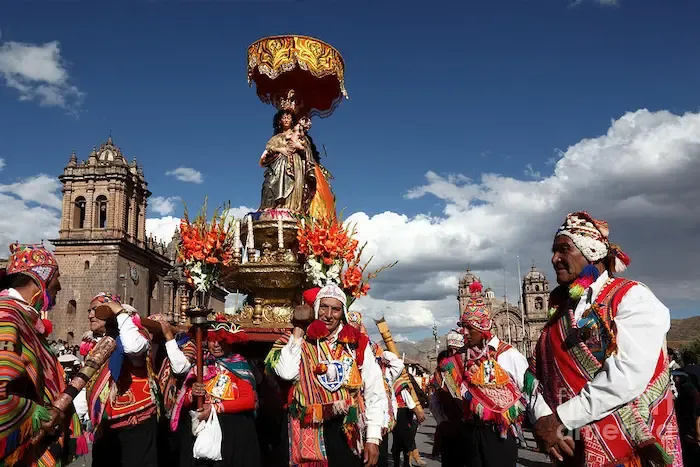
In Cusco, this festivity is observed with great devotion. Images of saints and virgins from different parishes are carried in procession to the Cathedral. The celebration blends Catholic elements with Andean traditions, music, dances, traditional food, and strong community participation. One of the most iconic dishes of this date is chiriuchu, a traditional Cusco dish typically served cold.
In Cajamarca, Corpus Christi is also hugely important. The celebration includes Masses, processions, and decorative carpets made from flowers and dyed sawdust.
Workers’ Day
2. Battle of Arica and Flag Day
On June 7, Peru commemorates the Battle of Arica and Flag Day. This date honors the sacrifice of Peruvian defenders during the War of the Pacific, especially the figure of Francisco Bolognesi.
It’s a civic, patriotic date. Schools, public institutions, and city squares hold ceremonies, flag-raisings, parades, and tribute events. In 2026, June 7 falls on a Sunday and is listed as a national holiday on Peru’s official government calendar.
How to Have Good Posture
3. Inti Raymi
Inti Raymi, known as the Festival of the Sun, is celebrated every June 24 and is one of the most important festivities in Peru. Its main stage is Cusco, where a grand historical reenactment takes place at iconic sites like the Qorikancha, the Plaza de Armas, and Sacsayhuamán.
This celebration has Inca origins and pays tribute to the Sun, regarded as the source of life, energy, and fertility. Today, Inti Raymi draws thousands of visitors from Peru and abroad. It’s celebrated with traditional costumes, music, dances, symbolic ceremonies, and a staged performance that recalls the greatness of the ancient Inca Empire. According to the Andina News Agency, its central date is June 24, and it has been declared part of the nation’s Cultural Heritage.
4. Feast of San Juan
The Feast of San Juan is also celebrated on June 24, especially in the Peruvian Amazon, in regions such as Loreto, San Martín, Ucayali, Amazonas, and Madre de Dios.
It’s a religious and popular celebration dedicated to Saint John the Baptist. In the Peruvian jungle, it’s celebrated with great joy — music, dancing, fairs, contests, cultural activities, and family gatherings. One of the most representative elements of this feast is juane, a traditional dish made with rice, chicken, egg, olives, and spices, usually wrapped in bijao leaves.
Throughout June, the Feast of San Juan can include dance competitions, exhibitions, musical performances, and craft and food fairs.
5. Farmers’ Day
Farmers’ Day is celebrated throughout Peru every June 24. This date honors the work of the men and women of the countryside, who play an essential role in the nation’s agriculture, food supply, and economy.
It’s a festivity of great social and cultural value. Many Andean regions hold agricultural fairs, ceremonies giving thanks to the land, school activities, contests, dances, and tributes to farming communities.
This date is linked to ancient agrarian celebrations and to the historic recognition of rural communities. According to the Peruvian government, June 24 marks both the Feast of San Juan and Farmers’ Day.
6. National Ceviche Day
National Ceviche Day is celebrated every June 28. It’s a date dedicated to one of the most iconic dishes in Peruvian cuisine.
During this celebration, restaurants, ceviche spots, food fairs, and institutions promote eating ceviche and other seafood dishes. Ceviche is considered a symbol of Peruvian cuisine and is typically made with fresh fish, lime, onion, chili pepper, salt, and other ingredients that vary by region.
Peru’s Ministry of Production has stated that this date was established in 2008 through Ministerial Resolution No. 708-2008-PRODUCE.
7. Saints Peter and Paul
June 29 marks the feast of Saints Peter and Paul, a Catholic religious festivity and also a national holiday in Peru.
This date has special meaning in fishing communities, since Saint Peter is considered the patron saint of fishermen. Many coastal towns and ports across the country hold Masses, maritime processions, boat blessings, fairs, and community activities.
On Peru’s official government calendar, Monday, June 29, 2026, is listed as a national holiday for the Feast of Saints Peter and Paul.
Conclusion
June brings together several important dates, which is why the month feels so special. Some remind us to care for the environment, like World Environment Day and World Oceans Day. Father’s Day also falls in June, alongside religious celebrations like San Juan and Corpus Christi, and a tradition as iconic as Inti Raymi.
Each one has its own meaning. Some are meant to be enjoyed with family, others invite us to pause for a moment, give thanks, or reflect on our roots. That’s why June festivities aren’t just dates on a calendar — they’re moments to feel closer to family, community, nature, faith, and culture.
Getting to know June’s festivities also helps us better understand our customs and experience the month with more history, joy, and learning.
By Diego Ramos — May 5, 2026